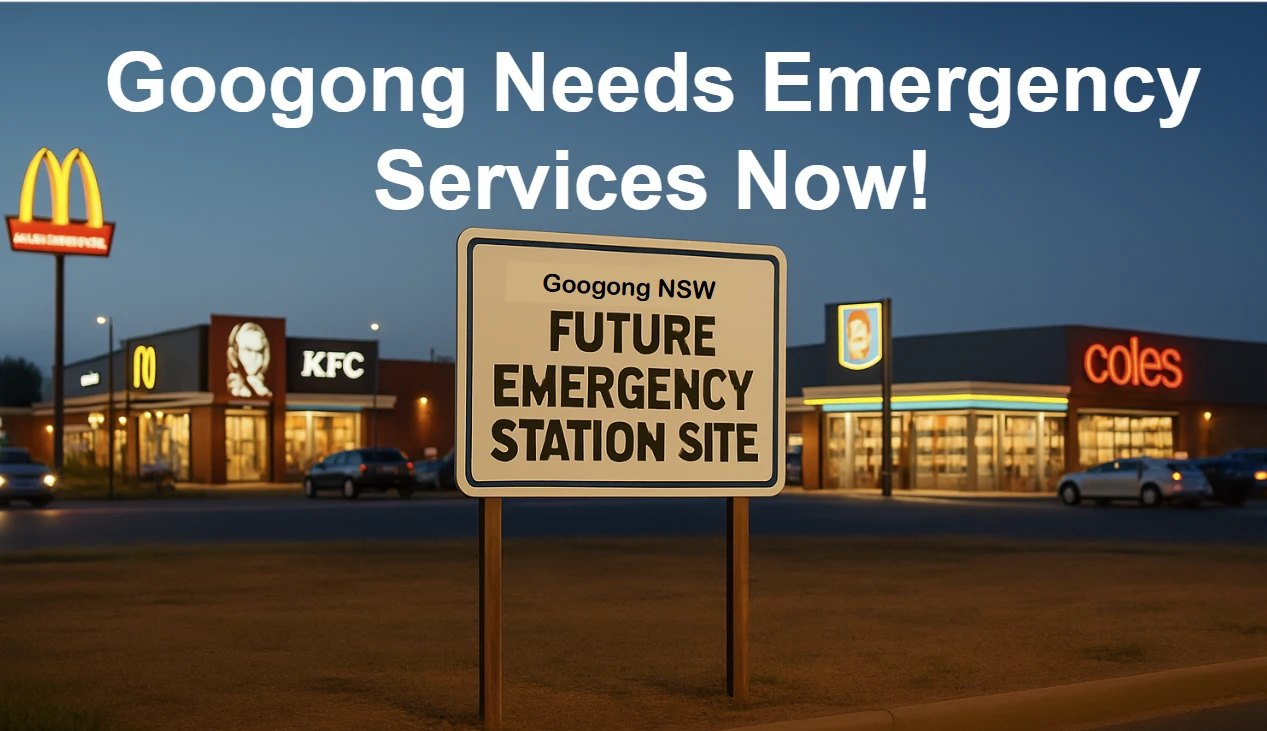
Googong grew 9.7% in 2024–25, the fastest growth outside Australia’s capital cities. About 22,500 people are projected by 2041. The ambulance still drives 13–16 minutes from Queanbeyan. The rural fire brigade’s median response is 17 minutes.
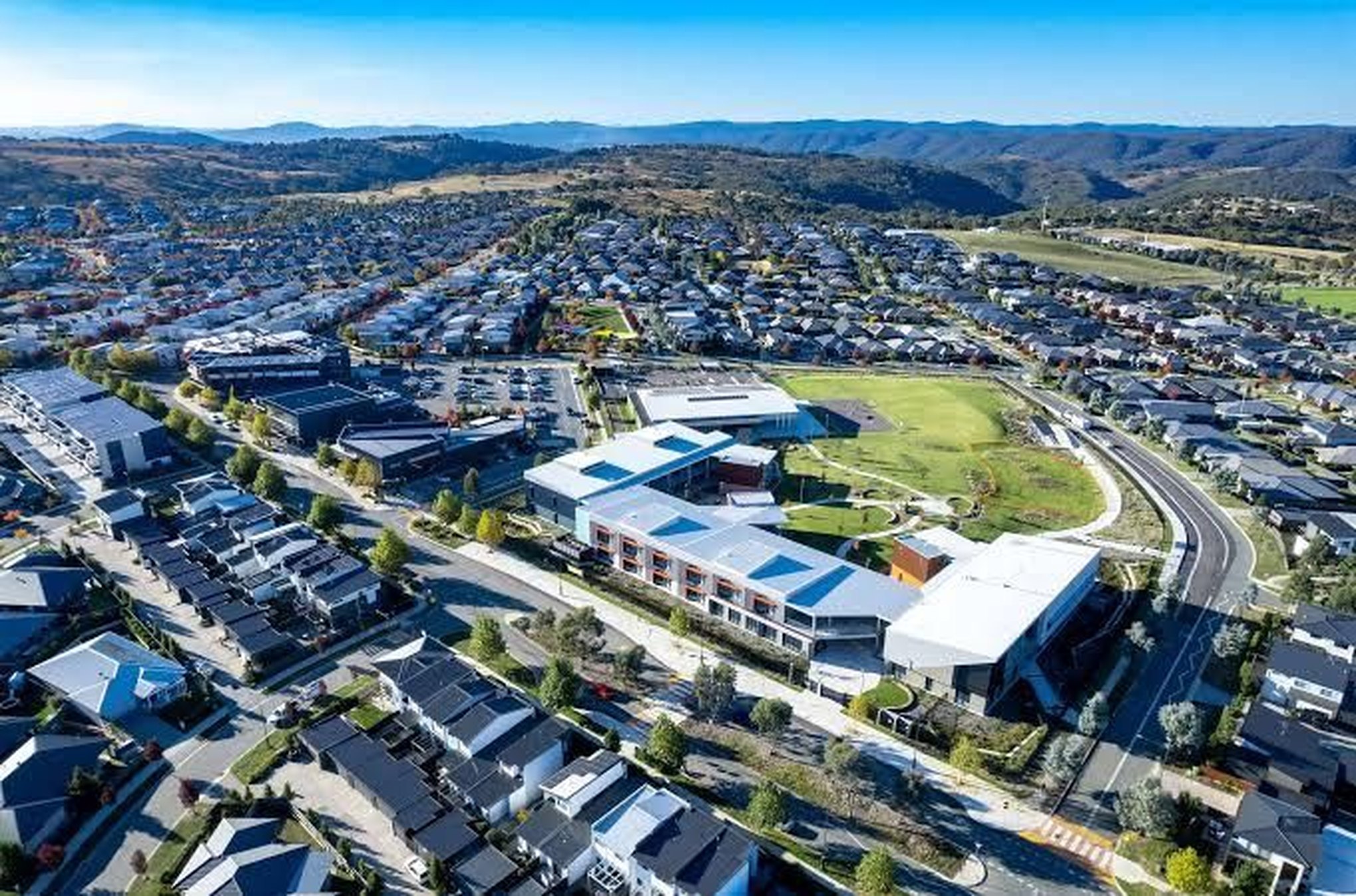
Schools, the oval, the shops and the streets are already in. The hills behind them are still being built on. About 10,200 people live here now, and around 2,000 children attend local schools and early-learning centres each day. The council’s projection is about 22,500 people by 2041.
None of that puts an ambulance or a fire truck in the town.
What-if
Send a crew. Watch the minutes.
Pick the emergency and the street. The ember truck leaves from today’s station. The light truck leaves from a hub inside Googong. Times are indicative road travel, not an official response.
NSW Ambulance, Erin Street Illustrative hub, Observer St & Wellsvale Dr
Today
14 min
Queanbeyan ambulance
13.9 min on the road · 10.5 km
If the hub existed
2 min
Township hub
2.0 min on the road · 1.2 km
0:00
Both are moving. The township hub is closer by 12 minutes.
Road times are OpenStreetMap estimates between fixed points, calculated once and baked in. Scroll on the map to zoom. It stays where you leave it. Use “See the hub” to look inside Googong. These are not live traffic, not Google, and not NSW Ambulance or fire-service response statistics. A real response also includes call-taking. For an ambulance, this assumes a Queanbeyan crew is free to leave. One childcare emergency on the public record waited 25 minutes for a crew that came from Bungendore.
The proposal
One site. Three services.
A 2,500 m² site set aside for a fire station, reported at $2.25 million, is sitting vacant in Googong. Use it once, well: an emergency services hub with an ambulance station, a Googong RFS station and a police touchdown office.
Ambulance station
A local base for NSW Ambulance crews, with vehicle bays, equipment storage and space for training and community first responders. Fourteen extra paramedics are already funded for the Queanbeyan area from early 2027. Some could be based here.
Googong RFS station
A purpose-built station in the town, near the volunteers and near about 85% of the brigade’s incidents. A large urban pumper for multi-storey buildings, safe PPE handling and decontamination areas.
Police touchdown office
Not a staffed police station. An office, an interview room and parking so officers on patrol can stop, work and be seen in Googong, including at events like Googfest.
The head start
A township crew gets there first.
Most volunteers live in Googong. Today they drive out to the station first: a 9-minute median turnout, then the drive back in. From a station in town, we estimate a 5-minute turnout.
Our Place childcareabout 7 min
Monaro Highway at Royallaabout 17 min
Today’s brigade median is 17 minutes. So most calls, inside the town, would be reached much sooner. Calls out on the highway would be reached in about the same time as now. Estimates: 5-minute turnout plus OpenStreetMap drive times, not RFS figures.
Why not the 2011 fire station plan?
A costly, untested concept.
The Googong Master Plan marked a future Fire and Rescue NSW station in 2011. No funded project, design or date has been published.
It would be an on-call (retained) station: one truck and about 12 firefighters paid per call. At 50 calls a year that is about $4,000 a call, up to $200,000 a year in wages alone. That is a campaign estimate, not an audited cost.
The NSW Auditor-General reported about 600 on-call firefighter vacancies across 206 stations in December 2025. A new station could struggle to staff its truck.
The RFS would still be needed as backup, and it would not fix the slow response outside the town.
Keep Queanbeyan. Add Googong. Nothing moves out of Queanbeyan. Station 428 keeps its full-time and retained firefighters, and could be strengthened too.
Leave room for Fire and Rescue later. Agree the triggers now: population, building height, incidents and response times. If they are met, Fire and Rescue could join the hub.
Shared sites already work: the ACT co-locates ambulance and fire stations, Surf Beach houses RFS and SES next to an ambulance station, and Mansfield is planning an emergency services precinct. The Googong site’s ownership, boundaries and suitability still need to be confirmed.
Same size of town
NSW is designing a station for Huntlee. Googong still has the longer drive.
Both are planned for 20,000 people or more. NSW is already designing an ambulance station for Huntlee. Googong still starts from Queanbeyan.
Googongfrom Queanbeyan
13–16min
Huntleefrom Branxton
4–6min
About 7–12 minutes longer for Googong. Road travel only. Huntlee’s new station is not open yet, so this uses Branxton.
Median minutes from the brigade being alerted to arriving, across 130 incidents from July 2023 to June 2026. One in ten took 21 minutes or more. Median turnout alone: 9 minutes. About 85% of incidents in 2024–25 were inside the town.
35
Fire & Rescue calls to Googong in the released tables: 8 in 2024, 16 in 2025, 11 in 2026 up to that release. Every one came from Queanbeyan.
14
More paramedics announced for Queanbeyan on 31 July 2026, due in early 2027. The announcement does not say how many will serve Googong or where they will be based.
Rural fire incidents: 42 in 2023–24 · 50 in 2024–25 · 38 in 2025–26. Latest year to 9 June.
What the documents show
Fire and Rescue NSW. The 2011 Master Plan site was later handed to the NSW Government. It is still vacant. No funded project, design or date.
NSW RFS. The RFS asked the council for land for “a new brigade station in Googong”. In April 2024 the council told Parliament it supports the need but has no money set aside for the land.
No plans on file. A GIPA request asked the RFS for any plans to rename, relocate or improve the Googong brigade. On 31 August 2026 it said it held no such records.
A new name, the same stations. Seventeen days later, on 17 September, Jerrabomberra Creek RFS renamed itself Googong RFS. It still operates from Royalla and Fernleigh Park. No crew moved and no response time changed.
Still unanswered
Is the plan an RFS station, a Fire and Rescue station, both, or neither?
Is either one funded, approved and scheduled?
Will any of the 14 new paramedics be based in Googong?
When will Googong get the local station it needs now?
A NSW Ambulance GIPA request is still waiting on a reply.
Residents’ accounts. Not an ambulance or fire log.
17 minutes. An ambulance to a child at Our Place. The next one came from Bungendore, 25 minutes.
More than 20 minutes trying to find a crew, then told to drive their daughter to emergency themselves.
An urgent call at a local sports event. The ambulance came from Canberra, about 30 minutes or more.
Council’s July 2026 example notice. $388 more than the same example last year.
Most of that jump is water, sewer, waste and stormwater. The ordinary rate barely moved. None of it stations a crew in town.
Average ordinary rate, 2026–27
Googong3,538 residential assessments
$2,546
Queanbeyan urbanSame council
$2,226
BungendoreSame council
$1,594
Googong has the highest average ordinary residential rate in the council’s table. The council’s draft accounts put its emergency services levy at $1.78 million last year, for Fire and Rescue, the RFS and the SES across the whole council. Councils also carry RFS land, buildings and upkeep. An ambulance or Fire and Rescue station is a state decision.
Why one shared site costs less
$2–2.5mIndicative cost of each extra site if the ambulance and RFS stations are built separately. Up to $5 million for two.
$0Extra paramedic positions, if some of the 14 already funded are based in Googong. NSW Ambulance would need to agree.
One buildOne design, one approval and one set of site works, instead of two or three. A volunteer RFS station before the ongoing wages of a retained one.
All figures are indicative and need checking by the agencies. The aim is NSW Government funding, so the cost does not land on Googong ratepayers.
The campaign is asking the NSW Government to fund and deliver it, with suitable land provided. Nobody can promise zero rate impact until land, funding and agency arrangements are agreed. The aim is to keep the cost off Googong ratepayers.
Are we trying to move services away from Queanbeyan?+
No. Queanbeyan keeps its ambulance station and Fire and Rescue Station 428 with its full-time and retained firefighters. The hub adds capability in Googong, which should also mean fewer Queanbeyan crews drawn away to Googong calls.
Why can’t Googong rely on Queanbeyan and ACT ambulances?+
Queanbeyan’s based ambulances cover a wide area, and Bungendore’s is part-time. Dispatch sends the closest available crew, including across the border, but ACT services are under pressure too. Help from further away is not the same as local cover.
Do the 14 new paramedics mean a Googong station?+
No. The July 2026 announcement adds 14 paramedics for Queanbeyan and surrounding communities from early 2027. It does not say how many will serve Googong, where they will be based, or whether a Googong station will open.
Didn’t Googong just get its own RFS brigade?+
The brigade changed its name from Jerrabomberra Creek to Googong RFS in September 2026. It still operates from Royalla and Fernleigh Park. No station has been built in the town.
Is the 2,500 m² site secured?+
Not yet. Its ownership, boundaries, availability, planning controls and suitability for all three services still need to be confirmed.
Are the $4,000-a-call and $200,000-a-year figures official?+
No. They are campaign estimates of wages for a retained Fire and Rescue station at 50 calls a year. They are not audited costs or confirmed savings.
What if Googong later needs a full Fire and Rescue station?+
The hub keeps that option open. A formal review against agreed triggers (population, building height, incidents, response times) would decide, and Fire and Rescue could join the hub.
To the Member for Monaro, the health minister, the emergency services minister, or council.
I live in Googong. About 10,200 people live here now, and the council projects about 22,500 by 2041. There is still no ambulance or fire station in the town.

An ambulance from Queanbeyan is a 13–16 minute drive, and only if a crew is free. That is a road estimate, not a logged response time. Our rural fire brigade’s median response is 17 minutes from alert to arrival.

A vacant 2,500 m² site set aside for a fire station is already in Googong. Please use it for an emergency services hub: an ambulance station, a Googong RFS station and a police touchdown office.

Please publish a funded plan and a date.
Campaign contact
A response-time story you will put on the record, or a correction.
This page was built so neighbours can see the same documents. It is a campaign, not an official site of NSW Ambulance, Fire and Rescue NSW, the Rural Fire Service, NSW Police or the council.
Growth
The people are in Googong. The ambulance is still in Queanbeyan.
About 10,200 people now. About 22,500 by 2041. More paramedics at Erin Street still leave from Erin Street.
22,593
projected residents in 2041, up from about 10,212 now
If calls simply follow the people
35
Fire & Rescue jobs in Googong a year by 2041, starting from 16 calls in 2025.
A simple scaling, not a forecast by any agency. It assumes calls grow in step with the population.